-Palauan proverb
Climate change refers to significant, long-term shifts in global weather patterns and temperatures, primarily driven by increased concentrations of greenhouse gases like carbon dioxide in the atmosphere. These changes result from human activities such as burning fossil fuels, deforestation, and industrial processes. These greenhouse gases trap heat in the earth’s atmosphere resulting in the rise of global average temperature, melting polar ice, sea-level rise, and more frequent extreme weather events, all of which pose substantial risks to ecosystems and human societies. In Palau, these global changes manifest as higher temperatures, stronger typhoons, coral reef loss, and coastal flooding, presenting significant challenges to Palau’s economy, environment, and communities.
Climate variability refers to fluctuations in climate conditions over shorter timescales — seasons to decades — driven by natural cycles in the ocean-atmosphere system. Although natural climate cycles and other factors affect temperatures and weather patterns at regional scales, especially in the short term, the dominant mode of variability affecting Palau is the El Niño-Southern Oscillation (ENSO), an irregular two-to-seven-year oscillation between warm (El Niño) and cool (La Niña) sea surface temperature patterns across the tropical Pacific. El Niño conditions suppress rainfall, lower sea levels, and raise ocean temperatures in Palau’s region, significantly increasing coral bleaching risk; La Niña conditions have broadly opposite effects. At longer timescales, the Pacific Decadal Oscillation (PDO) and Madden-Julian Oscillation (MJO) further modulate rainfall, sea level, and tropical cyclone activity. As long-term climate change raises baseline temperatures, even moderate ENSO events are expected to produce impacts sectors in Palau that would previously have required stronger events.
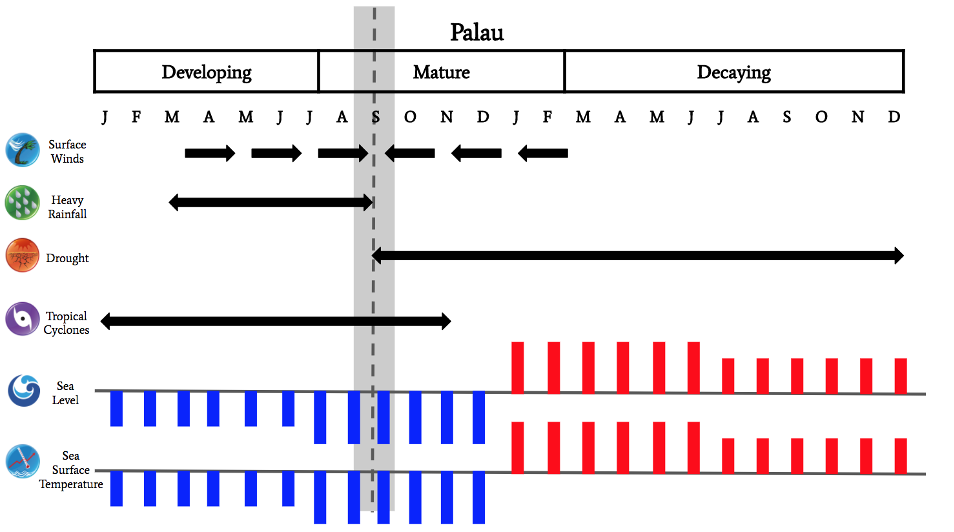
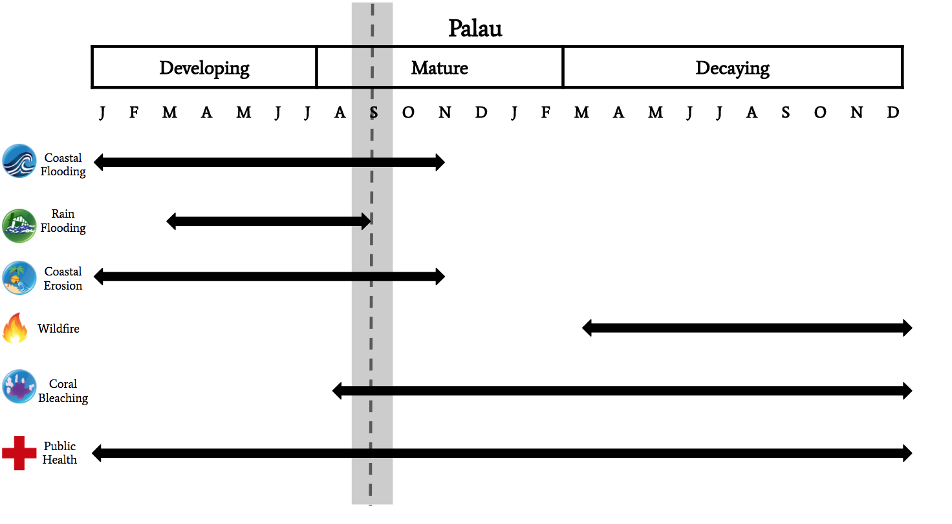
For information on climate variability, observed and projected changes, and projected impacts in the Pacific region, please visit the Pacific Climate Change Monitor. For a country-specific look at the impacts of climate change across sectors in Palau, please visit the Climate Change Monitor and Palau Pacific Islands Regional Climate Assessment (PIRCA).
Root crops are generally limited by disease and pets, which are expected to increase activity with the predicted rise in temperature. Many traditional taro patches are also in low-lying areas vulnerable to saltwater intrusion due to sea level rise. Several taro patches on Babeldaob are currently affected by this, especially during high tides. Salt water in taro patches can result in crop loss as high as 75-100%. A 2014 study to evaluate varietals for salt tolerance in Ngimis, Ngatpang, Ollei, and Ngarchelong, found that the Kirang, Dirrubong and Dungersuul varietals were most salt tolerant (Del Rosario et al. 2014). Efforts to preserve taro varieties and to conduct research to determine which varietals are salt-tolerant are led by institutions like Palau Community College’s Cooperative Research & Extension, which maintains 68 varieties.

 English